Most enterprises don’t realize how much they’re missing out on by connecting their agents directly to MCP servers. Let’s unpack where this massive scope of missed opportunity arises from.
Imagine you run a pediatrician’s office with three doctors and two secretaries. One doctor covers orthopedics, one covers ENT (ear, nose, and throat), and the third is a general practitioner that can do both. One of the secretaries is responsible for managing the front desk and showing patients to the correct room, and the other one is responsible for managing all client communication and scheduling. Now imagine each of these employees get an assistant, but the assistants are not able to communicate with each other. The assistants know their own workflows perfectly, but they never collaborate, so you’re still managing all the handoffs. That’s how independently integrating with first-party MCP servers works.
With the rapid adoption of MCP, more and more of our favorite software platforms have their own MCP servers for our agents to connect to. However, things can easily go wrong when you’re running a medium to large-sized organization with different teams and individuals, each connecting to a multitude of MCP servers. Some of examples of these include:
On top of the operational bottlenecks that come from independently connecting to multiple MCP servers, security risks can quickly spiral out of control. If each team in your organization is installing their own MCP servers, there’s no way to stop them from potentially downloading a malicious server. No enterprise-wide namespaces means that tool shadowing is an easy option for an attacker when targeting your organization.
Lack of permissioning and RBAC (role-based-access-control) means that anyone in your organization has the full power of all available tools in their hands and can get access to sensitive data or privileged actions. Prompt injection, the #1 OWASP AI Security Risk, could be accomplished through any customer support chatbot or intake form. Upholding compliance certifications and standards becomes impossible if your organization can’t answer “what can our agents do? Who authorized it? What are the entry points to our systems? What changed and when?”
There are a few contrary arguments that favor a centralized MCP registry to catalog MCP servers.
In the world where enterprises stitch together dozens of overlapping tools, what they need is an agentic layer that encodes their actual workflows. With all MCP servers under a shared registry, those complex workflows become possible.
All technical and non-technical members of an organization should be able to search for what tools and workflows are available for them to automate daily processes and perform in-depth analysis.
Instead of every team pinning (or forgetting to pin) their own MCP dependencies, the shared registry becomes the single source of truth where versions are reviewed, approved, and promoted. Your team won’t fall into the trap of downloading malicious MCP server versions posing as legitimate ones (ex: Postmark MCP exploit) off the internet.
When all servers flow through a single registry, it becomes easy to implement least privilege access where team members only have permissions for the tools and servers they need. Furthermore, new employee onboarding becomes seamless and secure when you can set up a role in the shared MCP registry and grant those permissions to each new employee with that role.
With a single namespace across the company, tool collisions don’t happen which eliminates the possibility of tool shadowing attacks. Furthermore, imposing security controls on tools become easier when you have a well-defined and globally accessible set of parsers, sanitizers, and other security functions that can be applied to each tool.
With a shared registry, each tool, new integration, or update can go through an approval flow before it is accessible for use. Additionally, logs can be collected across all tool calls, making real-time auditing possible.
Trusted by companies like MongoDB and Wise, Credal provides you with a shared registry to enable those complex, multi-platform workflows that are essential to your company’s operations. With that single source of truth, your agent can consolidate data from Snowflake, Hubspot, Salesforce, and Zendesk, run analysis through a custom tool or Looker, and then share out that data with your team or external shareholders via Slack, OneDrive, or Notion (see full list of Credal integrations here).
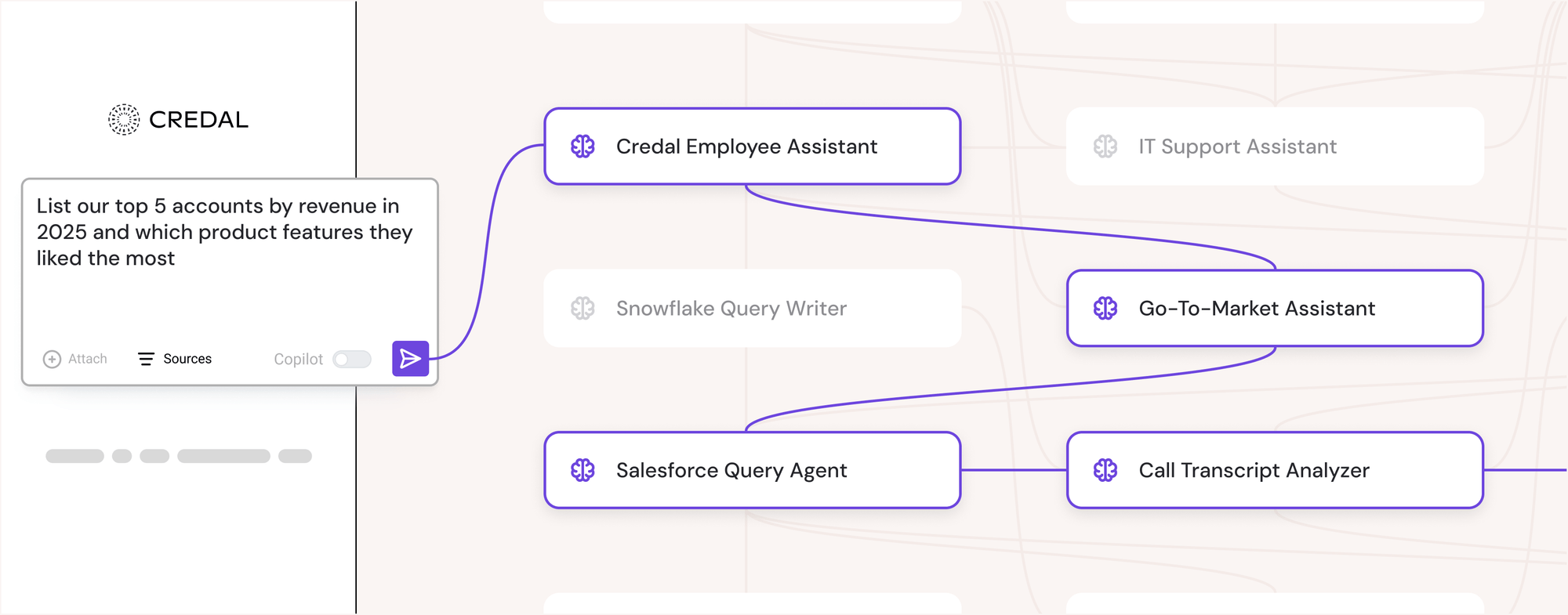
Credal pairs this flexibility with a security model that mirrors the permissions of your source systems, logs every agent interaction, and keeps your data fully controlled. It also supports zero-data-retention with model providers such as OpenAI, Anthropic, and Cohere and meets enterprise standards like SOC 2, HIPAA, and the EU-US privacy framework, so you can build workflows with the utmost assurance.
One of the key unlocks of a shared registry is the ability for both technical and non-technical members of your organization to easily deploy and use multi-platform agents. Generative workflows for customer service operations, financial reporting, IT support, employee onboarding and sales pipelines give back hours of time to your team members every day, allowing them to focus on business growth and strategic initiatives.
Another key unlock is the ease of oversight and governance. The registry provides a global control panel for auditing, permissions enforcement, and input/output monitoring, strengthening your security posture and simplifying compliance as agents interact with internal systems and sensitive data.
Now imagine your pediatrician’s office with a shared registry in place. Instead of working in isolation, all of the assistants are a part of a global system that understands the full set of office workflows. The registry knows which doctor handles which cases, what each secretary is responsible for, and which information each role is allowed to access. When a patient arrives, the assistants can route them correctly, update records, coordinate scheduling, and share the right information without you needing to manage handoffs. Every action is tracked, permissions are enforced automatically, and the entire office runs as a predictable and unified operation rather than a jumble of disconnected parts.
The case for an MCP registry is clear: a single source of truth means that agentic workflows don’t need to exist in siloes with humans still managing all handoffs and information transfer between first-party servers. Just like we can easily switch from Notion to Zendesk to Snowflake, agents should also be able to.
Credal is a pioneer in the space and the right choice for organizations that care deeply about security. Credal is believed to be the first organization to negotiate ZDR with OpenAI in early 2023, offers authenticated PCI-level penetration testing to attack and test application-security level logic, and is model agnostic so you can bring your agents to any chatUI with authentication.

One platform for all agents. Full visibility for admins, full access for teams.

One platform for all agents.
Full visibility for admins, full access for teams.